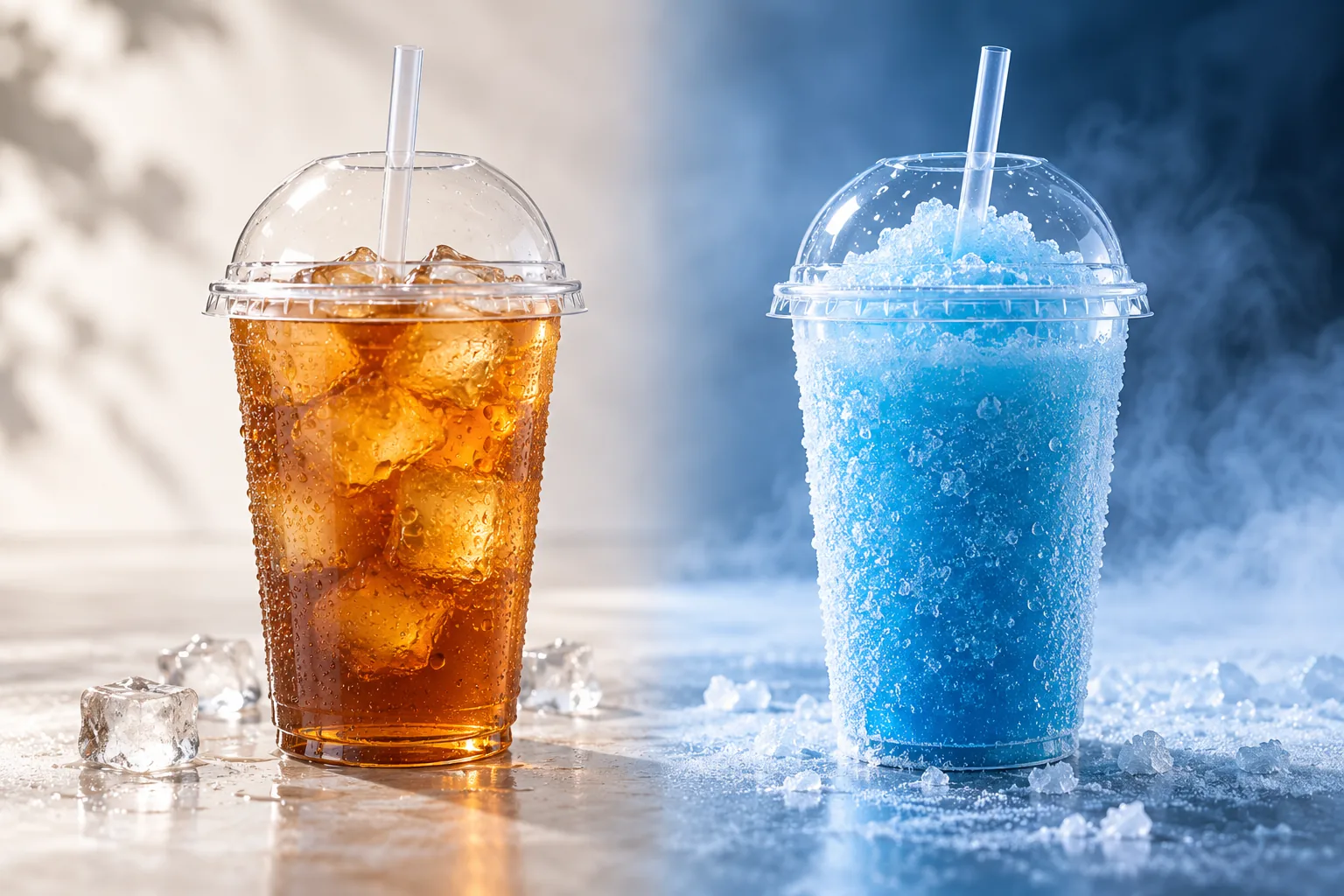
THE QUICK TAKE
Choose with the whole system in mind: drink, serving volume, cup, lid, handling and an evidence-backed collection route.
Regular PET cups are already widely used for iced coffee, fruit tea, juice, smoothies and other cold beverages. So when a buyer also sees a freezer-resistant PET cup range, the obvious question is:
When is a regular PET cup enough, and when should a freezer-resistant PET cup be reviewed instead?
The answer is not that one product is simply “better” than the other.
For B2B buyers, the real difference is the application condition.
A regular PET cold cup may be entirely suitable for conventional iced and chilled beverage service. Once the filled cup will actually enter a freezer, remain frozen for an extended period or be handled after freezing, the purchasing requirements change.
That is where a freezer-focused PET cup range becomes relevant.
Quick Comparison
| Buying Consideration | Regular PET Cold Cups | Freezer-Resistant PET Cups |
|---|---|---|
| Main use | Standard cold and iced beverage service | Projects involving freezer or demanding low-temperature exposure |
| Filled cup enters freezer | Not normally the primary use condition | Relevant application condition |
| Freezing temperature | Usually not central to selection | Should be specified |
| Frozen storage duration | Usually not central to selection | Should be specified |
| Post-freezing handling | May not apply | Can be important |
| Capacity and rim diameter | Important | Important |
| Lid compatibility | Must be confirmed | Must be confirmed |
| Main buying question | Which cup fits my beverage and serving format? | Which cup fits my beverage and freezer process? |
The key distinction is therefore not simply the word PET.
It is whether the application includes a defined freezer requirement.
Regular PET Cups: When They Are the Logical Choice
For standard cold-beverage projects, buyers normally begin with:
capacity → rim diameter → cup profile → lid → printing → quantity
This is the typical selection path for beverages such as:
- iced coffee;
- fruit tea;
- juice;
- chilled soft drinks;
- cold takeaway beverages; and
- other drinks served with ice but not stored frozen.
Ruige’s regular PET range follows this type of structure, with 12oz, 14oz, 16oz, 20oz and 24oz size groups and multiple rim families for cold beverage packaging projects.
If the beverage is filled, served and consumed without the cup going through prolonged freezer storage, adding a freezer requirement may not provide any practical benefit.
In that case, buyers are usually better served by focusing on:
- correct serving capacity;
- the right rim diameter;
- lid fit;
- cup profile;
- custom printing requirements; and
- commercial order conditions.
A regular PET cup is not an inferior version of a freezer-focused PET cup.
It is simply intended for a different purchasing scenario.
Freezer-Resistant PET Cups: When the Requirement Changes
The decision changes when the cup becomes part of a freezing process.
For example:
- the beverage is filled before freezing;
- the filled cup remains frozen overnight or for several days;
- the cup is moved or transported while still frozen;
- staff handle the cup immediately after removal from frozen storage; or
- the packaging is part of a low-temperature storage or distribution process.
These applications add variables that are normally not central to ordinary cold-cup sourcing.
The buyer now needs to consider:
temperature + frozen storage duration + contents + post-freezing handling
Ruige’s current freezer-resistant PET range has been internally tested at temperatures as low as -20°C. Under the disclosed test conditions, filled cups remained frozen for several days before evaluation and retained their structural integrity.
A post-freezing evaluation also involved an ice-filled cup being dropped from approximately 1 metre, with no cracking or shattering observed under those test conditions.
These results describe defined internal tests. They should not be expanded into a guarantee covering every beverage, freezer temperature, storage period or handling method.
The Simplest Decision Path
For many buyers, the selection can begin with three questions.
1. Is the cup only used for normal iced or chilled beverage service?
Start with Regular PET.
Focus on capacity, rim diameter, lid compatibility, cup profile and printing.
2. Will the filled cup actually enter a freezer or remain frozen for an extended period?
Review Freezer-Resistant PET options.
Temperature, duration, contents and post-freezing handling now become part of the product specification.
3. Are your actual conditions outside the supplier’s available test information?
Do not assume suitability.
Identify the difference and confirm whether additional project evaluation is required before ordering.
This decision path is more useful than assuming every cold drink needs a freezer-resistant cup—or that every PET cup automatically has the same freezer performance.
Not sure which PET cup range fits your project? Send the beverage type, whether the filled cup will be frozen, target temperature and expected storage duration. This is usually enough to determine which product range should be reviewed first.
Why “Cold Drink” and “Frozen Storage” Should Not Be Treated as the Same Requirement
A cup containing ice may feel very cold during normal service.
But this is not the same as a filled cup remaining inside a freezer for an extended period.
The distinction matters because the buyer is specifying two different packaging processes.
Example A: Iced Coffee
The cup is filled with iced coffee.
It may contain a large quantity of ice, but it is served shortly after preparation and never enters a freezer.
The selection process can remain focused on:
- serving volume;
- cup dimensions;
- lid style;
- presentation;
- printing; and
- quantity.
A regular PET cold cup is the natural starting point.
Example B: Filled Beverage Stored Frozen
The beverage is filled into the cup and then placed into a freezer.
It remains frozen before being removed, handled or transported.
Now the buyer should also define:
- freezing temperature;
- storage duration;
- whether the cup is frozen while filled;
- post-freezing handling; and
- whether the complete cup-and-lid system is involved.
That is no longer a normal cold-cup brief.
It is a freezer application.
Does “Freezer-Resistant PET” Mean a Special PET Material?
Not necessarily.
Buyers should avoid assuming that the term freezer-resistant PET automatically proves a specific material formulation, modification or proprietary production technology.
Unless the supplier has provided verified material information, those explanations should not be invented.
For purchasing purposes, a better comparison is based on:
finished cup specification + intended use + test conditions
rather than unsupported assumptions about material chemistry.
This prevents two opposite mistakes:
- assuming all PET cups behave identically simply because they are PET; and
- assuming every freezer-resistant PET cup must use some specific undisclosed material modification.
The product should be judged by what can actually be verified.
What Buyers Should Compare
When choosing between regular PET and freezer-resistant PET, compare the application requirements rather than only the product names.
Application
Will the cup be used for ordinary cold service or actual freezer storage?
Temperature
If freezing is involved, what is the expected temperature?
Duration
Will the cup remain frozen briefly, overnight or for several days?
Contents
Will the cup already contain the beverage during freezing?
Post-Freezing Handling
Will the cup be moved, transported or served while still frozen?
Cup Format
What capacity and rim diameter are required?
Closure
What lid will be used, and will the complete cup-and-lid package enter the freezer?
These questions usually produce a more useful comparison than simply asking:
“Which PET cup is stronger?”
Freezer Resistance Does Not Replace Normal Cup Selection
Even when a freezer-resistant product is appropriate, buyers still need to select the correct cup format.
Ruige’s current freezer-resistant PET range includes:
| Capacity | Top Diameter |
|---|---|
| 360ml | 95mm |
| 480ml | 93mm |
| 500ml | 92mm |
| 520ml | 98mm |
| 580ml | 98mm |
| 700ml | 95mm |
| 800ml | 107mm |
The published range covers 360ml to 800ml and several rim families.
That means “freezer-resistant” should be treated as one layer of the specification.
A more complete selection sequence is:
Application → Freezer Conditions → Capacity → Rim Diameter → Lid → Printing → Quantity
rather than choosing a freezer-resistant product first and reviewing the rest later.
This is especially important because two cups can share the same rim diameter while serving very different volume requirements.
For example, the current range includes:
- 360ml and 700ml with 95mm rims;
- 520ml and 580ml with 98mm rims.
The complete specification should therefore drive the final choice.
Lid Compatibility Still Needs Separate Confirmation
Whether the buyer chooses regular PET or freezer-resistant PET, nominal rim diameter should not be treated as final proof of lid fit.
Ruige’s regular PET pages already advise buyers to confirm the closure against the exact cup variant rather than relying only on nominal capacity or rim family.
For freezer applications, one more question should be added:
Will the complete cup-and-lid package enter the freezer together?
If yes, that process should be disclosed when the supplier reviews the project.
The lid is part of the packaging system, not an afterthought.
Regular PET vs Freezer-Resistant PET: Three Real Buying Scenarios
Scenario 1: Iced Beverage Shop
A beverage shop needs transparent cups for iced coffee and fruit tea.
The drinks are prepared for immediate takeaway and are never stored frozen.
Starting point: Regular PET.
The priority is cup size, rim, lid, profile and branding.
Scenario 2: Beverage Frozen After Filling
The buyer fills the beverage into the cup before placing it into frozen storage.
The cups remain frozen before distribution or service.
Starting point: Freezer-Resistant PET review.
The RFQ should include temperature, duration, contents and handling after freezing.
Scenario 3: Project Conditions Differ From Existing Test Conditions
A supplier has freezer-related test information, but the buyer’s process uses different temperatures, storage duration or handling.
Starting point: Additional project review.
The correct response is not to assume that existing results automatically transfer to the new condition.
This is especially important for larger orders where packaging performance needs to match an established production process.
Common Buying Mistakes
Treating Freezer-Resistant PET as an Upgrade for Every Cold Drink
A conventional iced beverage does not automatically require a freezer-focused cup.
Start with the actual application.
Assuming a Regular PET Cup Is Unsuitable Just Because It Is Not Marketed as Freezer-Resistant
Regular PET cups are designed for many everyday cold-beverage projects.
The question is whether the buyer needs a separate freezer condition—not whether regular PET can hold a cold drink.
Comparing Only Temperature Numbers
A temperature without duration, filling condition and post-freezing context provides an incomplete comparison.
Assuming “Freezer-Resistant” Explains the Material Technology
Do not add a material explanation unless the supplier has verified it.
Ignoring the Lid
Cup and lid requirements should be reviewed together, especially if the complete package enters frozen storage.
Asking for a Quote Without Describing the Application
“Please quote PET cups” gives the supplier much less useful information than a short explanation of the actual beverage process.
RFQ Checklist: Which PET Range Should Be Reviewed?
A concise project brief can help the supplier determine whether the enquiry belongs with the regular PET range or the freezer-resistant range.
| RFQ Item | What to Provide |
|---|---|
| Beverage | Intended contents |
| Application | Normal cold service or freezer exposure |
| Capacity | Required ml or oz |
| Freezing temperature | If applicable |
| Frozen storage duration | If applicable |
| Post-freezing handling | If applicable |
| Lid | Required style if known |
| Printing | Plain or custom printed |
| Quantity | Estimated purchasing volume |
| Destination | Country / market |
The key field is Application.
If the cup will never enter a freezer, say so.
If it will be frozen after filling, say that too.
That single distinction often determines which PET product family should be reviewed first.
Buyer Takeaway
The choice between freezer-resistant PET cups and regular PET cups should begin with the beverage process—not the product label.
Choose regular PET as the starting point when the project involves normal iced or chilled beverage service without prolonged freezer exposure.
Review freezer-resistant PET cups when the filled package will enter a freezer, remain frozen or be handled after freezer storage.
And if the actual application differs from the supplier’s documented test conditions, identify that difference before placing the order.
The practical question is not:
“Which PET cup is better?”
It is:
“Which PET cup has the right specification and supporting information for the way my beverage will actually be filled, stored and served?”
That is the comparison that matters in B2B sourcing.
Compare PET Cup Options for Your Project
If you are deciding between a regular PET cup and a freezer-resistant PET cup, send Ruige:
- beverage type;
- required capacity;
- whether the filled cup will be frozen;
- expected freezing temperature;
- expected storage duration;
- lid requirement;
- quantity; and
- destination market.
The project can then be reviewed against the relevant PET product range before a specific cup is confirmed.
Frequently Asked Questions
What is the difference between freezer-resistant PET cups and regular PET cups?
The main purchasing difference is the intended application. Regular PET cups are commonly used for standard cold-beverage service, while freezer-focused projects also require buyers to consider freezer temperature, frozen storage duration and handling after freezer exposure.
When should I choose regular PET cups?
Regular PET is the natural starting point when the cup will be used for normal iced or chilled beverage service and will not undergo prolonged freezer storage.
When should I consider freezer-resistant PET cups?
Review freezer-resistant PET cups when the filled cup will enter a freezer, remain frozen for an extended period or be handled after freezer exposure.
Are freezer-resistant PET cups made from a different PET material?
The product name alone does not establish a specific material formulation or modification. Unless verified material information is provided, buyers should compare the finished cup, intended application and relevant test conditions.
Are freezer-resistant PET cups stronger than regular PET cups?
“Stronger” is too broad to be a useful sourcing claim. The relevant comparison is whether the specific cup has been evaluated under the low-temperature conditions required by the project.
What temperature are Ruige freezer-resistant PET cups tested at?
Ruige’s current freezer-resistant PET range has been internally evaluated at temperatures as low as -20°C. This is a defined internal test condition and not a universal temperature limit for all PET cups or applications.
Do I need freezer-resistant PET cups for iced coffee?
Not necessarily. If the cup is used for normal iced-coffee service and is not subjected to prolonged freezer exposure, a regular PET cold cup may be the appropriate starting point.
What information should I include in my RFQ?
Include the beverage type, capacity, whether freezer exposure is involved, expected temperature and duration where applicable, lid requirement, quantity, destination and printing requirements.